The Common Table
Every Monday, I try a new coffee shop. It’s part writing routine, part research. I love watching how people inhabit spaces, how strangers navigate proximity, what makes a place feel like itself.
This morning’s discovery is a gem I found by accident. The place I was aiming at is closed on Mondays. So I wandered into this place, around the corner.
Show tunes play softly in the background. About twenty people are scattered throughout the space, each seated in a different style of chair at equally eccentric tables. A pregnant woman talks on her phone from a gold damask settee, effortlessly balancing her breakfast plate on her lap.
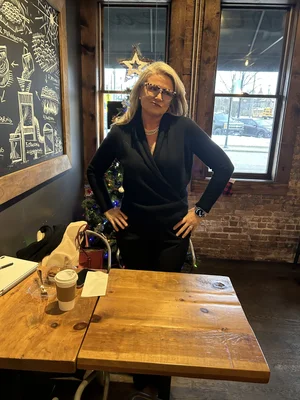
I’ve claimed the head of the communal table, a long wooden dining table that has twelve mismatched chairs. Mine has arms, which makes it the leader seat by default. I’m eating their breakfast sandwich on toasted ciabatta, which is a good start to any sandwich. The egg soufflé, heirloom tomato, and applewood smoked bacon don’t hurt.
The vibe here is serious. People hunched over laptops aren’t looking for community, they’re here to work. Although when someone sits down at the communal table, they do apologize first. It is the Midwest, after all.
My first impression: this place couldn’t exist in Blue Lake. It’s too studied, too self-aware. The ceramic bird perched on a ceramic llama announces “look how quirky we are.” There’s a Seurat street scene mural, gilt-framed prints, a flower portrait sitting behind a frame instead of in it. A bar cart displays business cards of insurance agents, spas, realtors, and florists all being ignored together. Even with the floor covered in a thick paste of water and salt from patrons feet I still think it’s too cosmopolitan for Blue Lake.
And then three men sit down at the common table.
The energy shifts immediately. They settle in with the comfortable authority of regulars, launching into the easy banter of people who’ve been meeting here for years.
“Dennis turns eighty-nine on Saturday,” Francois announces to the table, running a hand through his tousled grey hair. Francois has an expensive watch and an air of quiet luxury. “Says he’s bringing one of his girlfriends. Hasn’t decided which one yet.”
“That’s because he can’t remember their names,” says Jon, a retired lawyer who is wearing a suit, which is unusual enough to prompt comments. “Last week he called Suzy ‘Linda’ three times.”
Dennis, who is slightly hunched and dressed more humbly than his friends, waves this off and turns to me. “Francois is a spy.” I’m dubious.
They’re salty about sitting here today. Apparently, interlopers took their reserved table. Two or three years ago a generous Christmas gift to the staff earned them a sign designating their table “for the old timers”. This affront has thrown off the entire morning. We all turn and glare at the young professionals seated at the round table up front. Harumph.
I watch them for a while—this accidental community that forms every day but Sunday. Dennis with his rotating girlfriends. Jon still prosecuting traffic court because retirement doesn’t mean stopping. Francois and his mysterious past.
I take it all back.
This place absolutely could exist in Blue Lake. Every small town has its common table, its regulars who claim the same seats, its rotating cast of characters with their well-worn stories. The setting might be more studied here, but the human element? That’s universal.
The difference between fiction and real life: in fiction, I’d never get away with a character named Francois who’s a spy. Too on-the-nose. But here he is, speaking in a distinctly South African accent, while Dennis debates him about which girlfriend to bring to his birthday party.
Blue Lake has its own common tables. The counter at The Bluebird Diner. The booths at the Three Swine Pub. The “old timers” table at The Black Cat Coffee Roastery. Benches in the square where the same people appear every morning, drawn by routines they’d be hard-pressed to explain.
And I’m reminded why I write mysteries set in a small town. Because the real mystery isn’t who committed the crime. It’s how these unlikely communities form, persist, and become the thing we can’t imagine living without.
Even when someone takes your regular table.
Especially then